Ultimate SEO Guide 2026
/ /
How to Rank Websites in Google, AI Search & Beyond
Search Engine Optimization (SEO) continues to evolve every year. With the rise of AI-powered search engines, Google AI Overviews, and generative search, ranking a website in 2026 requires more than just keywords and backlinks.
In this guide, we will cover modern SEO strategies that actually work today, including technical SEO, AI search optimization, content strategy, and practical methods to improve your website’s visibility.
Whether you manage your own website or work with clients, this guide will help you build a strong SEO foundation that can generate long-term organic traffic.
What is SEO?
SEO (Search Engine Optimization) is the process of improving a website so that it appears higher in search engine results such as Google.
The goal of SEO is simple:
- Increase organic traffic
- Improve search visibility
- Attract relevant users
- Generate leads and conversions
Good SEO helps search engines understand:
- what your website is about
- which keywords your pages should rank for
- whether your website is trustworthy and useful
How Search Engines Work
Search engines follow three main processes:
Crawling
Search engines use bots (also called spiders) to scan websites and discover pages.
Indexing
After crawling, pages are stored in a database called the search index.
Ranking
When someone searches for something, search engines analyze hundreds of ranking signals to show the most relevant pages.
These signals include:
- Content quality
- Page speed
- Backlinks
- User experience
- Topical authority
The 4 Pillars of Modern SEO
- Technical SEO
- On-Page SEO
- Content Strategy
- Off-Page SEO
Technical SEO
Technical SEO ensures that search engines can crawl and understand your website properly.
Key technical factors include:
- Website speed
- Mobile friendliness
- Clean URL structure
- XML sitemaps
- Proper indexing
- Schema markup
Common technical SEO issues include:
- Pages not indexed
- Slow website loading
- Duplicate content
- Broken links
Fixing technical issues is often the first step before any SEO strategy.
On-Page SEO
On-page SEO focuses on optimizing individual pages.
Important elements include:
Title Tag
The page title is one of the strongest ranking signals.
Example:
Ultimate SEO Guide 2026 | Complete Strategy for Ranking Websites
Meta Description
Meta descriptions influence click-through rate.
Headings (H1, H2, H3)
Headings help both users and search engines understand page structure.
Keyword Optimization
Include your primary keyword naturally in:
- Title
- Headings
- Introduction
- URL
- Image alt text
Avoid keyword stuffing. Focus on topic relevance instead of repetition.
Content Strategy
Content is still one of the most powerful SEO drivers.
However, in 2026 the focus has shifted from keyword-based content to topical authority.
Instead of writing random articles, build topic clusters.
Example structure:
Pillar Page
Ultimate SEO Guide
Supporting articles:
- Technical SEO Checklist
- On-Page SEO Guide
- Keyword Research Guide
- SEO Audit Guide
Internal linking between these pages signals expertise to search engines.
Off-Page SEO
Off-page SEO focuses on authority and trust signals.
The most important factor remains backlinks.
Backlinks are links from other websites pointing to your content.
Quality backlinks can:
- Improve rankings
- Increase credibility
- Drive referral traffic
Some effective backlink strategies include:
- Publishing case studies
- Writing expert guides
- Creating free tools
- Guest blogging
- Digital PR
Avoid spammy backlinks or automated link building.
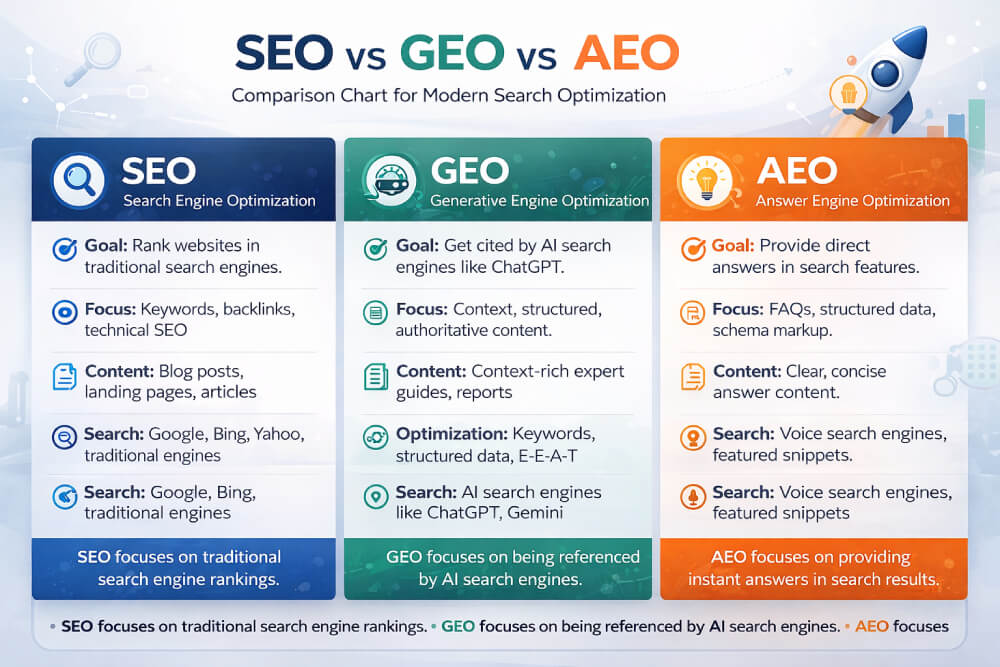
SEO for AI Search (AEO & GEO)
Search is no longer limited to traditional search engines.
AI tools such as ChatGPT, Gemini, and Perplexity now answer user questions directly.
This has introduced new concepts:
AEO – Answer Engine Optimization
Optimizing content to appear in AI-generated answers.
GEO – Generative Engine Optimization
Optimizing content so AI systems can reference it.
To improve AI visibility:
- Answer questions clearly
- Use structured headings
- Include FAQs
- Provide concise explanations
- Build authoritative content
Well-structured content increases the chances of being referenced by AI systems.
Common SEO Mistakes to Avoid
Many websites struggle with SEO due to common mistakes.
Some of the most frequent issues include:
- Publishing low-quality content
- Ignoring technical SEO
- Poor internal linking
- Focusing only on keywords
- Building low-quality backlinks
Avoiding these mistakes can significantly improve search performance.
The Future of SEO
SEO will continue evolving as search engines integrate more AI.
Future trends include:
- AI-generated search answers
- Conversational search queries
- Stronger focus on expertise
- Increased importance of topical authority
Websites that provide clear, structured, and valuable content will continue to perform well.
Content quality, topical authority, and technical SEO remain the most important ranking factors.
Yes. Organic search remains one of the most effective ways to generate long-term website traffic.
AI content can rank if it is high quality, helpful, and properly edited. Pure automated content without expertise often performs poorly.
Publishing 1–2 high-quality posts per week is generally considered a good frequency for steady growth.

Innovating and developing your ideas!
Quick Links
Cookie Consent
I use cookies to improve your experience on my site. By using this site, you consent to cookies.
Cookie Preferences
Manage your cookie preferences below:
Essential cookies enable basic functions and are necessary for the proper function of the website.
Statistics cookies collect information anonymously. This information helps us understand how visitors use our website.
Google Analytics is a powerful tool that tracks and analyzes website traffic for informed marketing decisions.
Service URL: policies.google.com (opens in a new window)