
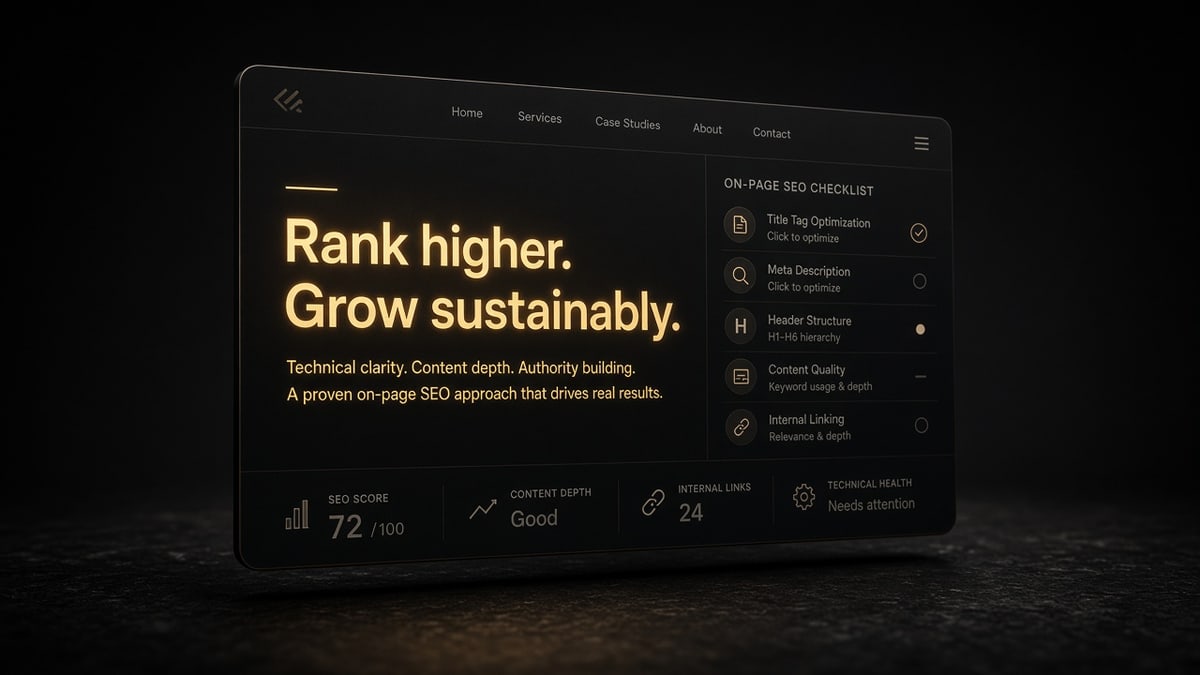
On-page SEO checklist 2026 is one of those phrases people search when they are done collecting tip lists and ready for a system.
If you manage a site in 2026, you do not need another vague pep talk. You need a clear definition, a practical sequence and a way to measure whether the work moved anything.
This guide keeps the human tone and the specialist standard: direct answers first, proof second, and no ranking fairy tales.
Quick win: Pick one priority URL related to on-page SEO checklist 2026. Rewrite the first 80 words as a direct answer, add one comparison table, and link two related pages from your cluster. That single pass improves clarity for people and AI surfaces.
What “on-page SEO checklist 2026” actually means
In practice, on-page SEO checklist 2026 is less about chasing a buzzword and more about making pages:
- Easy to crawl and index
- Matched to a real search job (intent)
- Clear enough to quote or cite
- Supported by experience — not recycled filler
Google’s own framing still points back to helpful, reliable, people-first content and solid technical foundations (Search Essentials, AI features guidance).
Why this topic ranks better with less competition
Broad head terms are crowded and often AI-Overview heavy. More durable opportunities usually sit in:
| Opportunity type | Example shape | Why it is often easier |
|---|---|---|
| Problem-specific long-tail | “how to fix X for Y stack” | Too specific for thin tip farms |
| Local / geo modifiers | “service + city + niche” | Map + relevance beats generic blogs |
| Commercial investigation | “best / vs / pricing / for [industry]” | Users still click to verify |
| Fresh process content | checklists, audits, templates | Experience beats recycled posts |
That is the competitive angle behind this article: useful specificity over vanity volume.
A practical framework you can run this week
1) Define the job of the page
Write one sentence: “This page exists so that ___ can ___.” If you cannot finish it, the page is a draft wearing a tuxedo.
2) Lead with the answer
Put a 40–70 word definition or outcome under the H1. Answer engines and humans both reward this habit — see also How to Optimize Content for Google AI Overviews.
3) Support with evidence
Add one of: a process table, before/after notes, a checklist, or a short case vignette from real work (portfolio).
4) Strengthen the cluster
Link related guides and services. Orphan pages are lonely for a reason.
5) Measure something observable
Track impressions, clicks, average position, AI Overview presence (when relevant), and conversions — not vibes.
Implementation checklist
| Step | Action | Done when |
|---|---|---|
| 1 | Confirm indexation in Search Console | URL is indexed or issue is logged |
| 2 | Rewrite title + first screen | Query job is obvious in 5 seconds |
| 3 | Add structured proof | Table, FAQ or example exists |
| 4 | Internal links | 2–4 contextual links to/from cluster |
| 5 | Baseline metrics | Screenshot + notes saved |
Common mistakes (said with love)
- Writing for algorithms instead of the person with the problem
- Targeting impossible head terms while ignoring winnable long-tails
- Shipping AI drafts with zero experience
- Ignoring technical blockers then blaming “the algorithm”
- Reporting only sessions while AI features reshape SERPs
Related reading on this site
Also useful: The SEO Handbook and contact if you want this implemented on a live property.
Frequently asked questions
Is on-page SEO checklist 2026 still worth targeting in 2026?
Yes — especially when you frame it as a specific job-to-be-done rather than a vague trend post. Specificity reduces competition and increases usefulness.
Will this guarantee page-one rankings?
No. Honest SEO improves eligibility and clarity. Competition, demand and trust still decide outcomes.
How often should I refresh this content?
Quarterly for high-intent pages, or sooner after major Google UI/AI feature changes.
References
- Google Search Central — Search Essentials
- Google Search Central — Optimizing for generative AI features
- Google Search Central — Creating helpful, reliable, people-first content
- Ahrefs — SEO trends
- HubSpot — Generative engine optimization
- Mudassir Hassan Khan — Ultimate SEO Guide 2026
- Mudassir Hassan Khan — The SEO Handbook
Free resource
The SEO Handbook (2026 Edition)
A practical playbook by Mudassir Hassan covering technical SEO, on-page SEO, AEO & GEO, local SEO and a 30-day operating system.
- 16 chapters + checklist
- AI search (AEO/GEO) included
- Built for real implementation
You're in. Download your copy:
Download PDF